


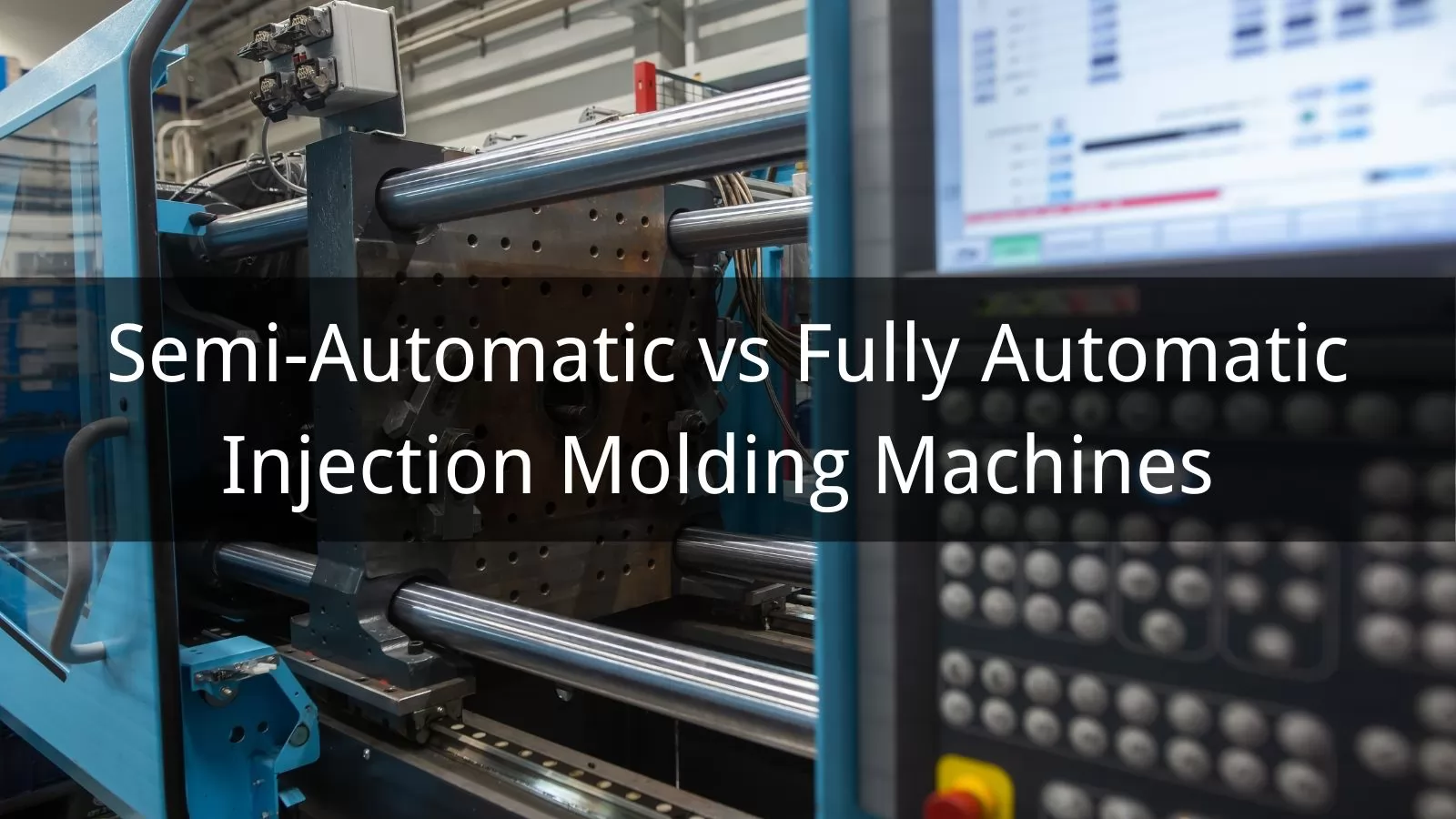
Injection molding remains one of the most widely used plastic manufacturing processes worldwide. While both semi-automatic and fully automatic machines share the same fundamental principles—melting plastic and injecting it into a mold under pressure—their level of automation dramatically changes labor needs, output, cost structure, and suitable applications. This in-depth 2025 guide compares them across 15+ real-world factors with updated data, examples, and cost breakdowns to help you make the right investment decision.
Table of Contents
- What Is a Semi-Automatic Injection Molding Machine?
- What Is a Fully Automatic Injection Molding Machine?
- Automation Level & Process Flow
- Purchase & Operating Costs (2025 Data)
- Labor Requirements & Skill Level
- Production Speed & Output Examples
- Setup & Changeover Time
- Part Precision & Defect Rate
- Energy Consumption & Efficiency
- Maintenance Complexity & Downtime
- Operator Safety & Modern Standards
- Flexibility for Low-Volume & Custom Runs
- Best Applications & Industry Examples
- Future Trends & Hybrid Solutions
- Which One Should You Choose in 2025?
- Conclusion
What Is a Semi-Automatic Injection Molding Machine?
_1764645487_WNo_1280d720.webp)
A semi-automatic injection molding machine (also called manual-assisted or semi-auto IMM) is a plastic molding system that automates the core injection and clamping process but still requires human operators for several key steps in each cycle.
How It Works (Typical Cycle)
-
Operator loads inserts (if any) or closes the safety gate.
-
Machine automatically closes the mold, injects molten plastic, cools, and opens the mold.
-
Operator manually removes the finished part (and sprue if needed).
-
Operator restarts the next cycle (or the machine waits for the gate to close).
The injection unit, screw plasticizing, clamping, and ejection stroke are fully powered (usually hydraulic or servo-hydraulic), but part take-out, insert placement, and quality checks are done by hand.
Key Features & Specifications (2025 Typical Range)
| Parameter | Typical Value (Semi-Automatic) |
|---|---|
| Clamping force | 30 – 1,200 tons (most common 80–600 t) |
| Automation level | 60–75 % automated |
| Cycle time | 20–60 seconds (depends on operator) |
| Price range (2025) | $12,000 – $85,000 |
| Common brands | Haitian Mars Lite, Yizumi UN, Chen Hsong JM, Bole, Borche, Powerjet |
Best Use Cases
- Low to medium volume (< 300,000 pcs/year)
- Insert molding (metal/plastic overmolding)
- Prototyping & sampling
- Frequent color or material changes
- Custom or short-run products (medical trays, promotional items, small electronic housings)
Advantages
- Lower initial cost
- Easy & fast mold changes
- Flexible for skilled operators
- Simple maintenance (fewer robots/sensors)
Disadvantages
- Higher labor cost per part
- Slower and inconsistent cycle times
- Higher defect rate due to human handling
- Cannot run “lights-out”
In short: Semi-automatic machines = affordable + flexible + operator-dependent Ideal for workshops, startups, and custom manufacturers who need hands-on control rather than 24/7 mass production.
What Is a Fully Automatic Injection Molding Machine?
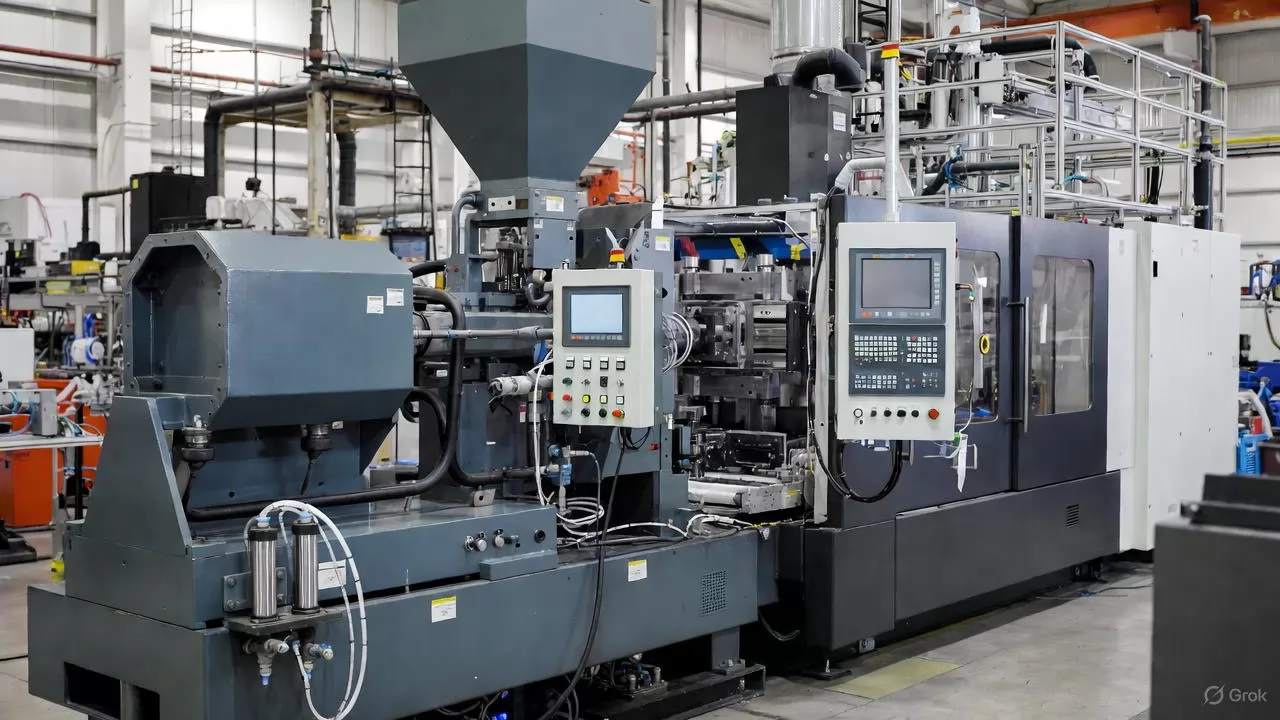
A fully automatic injection molding machine (also called full-auto IMM or lights-out IMM) is a complete plastic production system that runs the entire molding cycle with little or no human intervention. Once the mold is installed and parameters are set, the machine handles everything from raw material feeding to finished part stacking — 24 hours a day if needed.
How It Works (Typical 2025 Full Cycle – No Operator Touching Parts)
-
Auto material feeding – Vacuum loader + dryer keeps hopper full
-
Auto insert placement (if needed) – 6-axis robot or bowl feeder
-
Auto mold close → inject → cool → open – High-speed hydraulic or all-electric drive
-
Auto part ejection & removal – Robot arm or 3-axis servo picker
-
Auto sprue separation & regrind (optional)
-
In-line quality inspection – Vision system + auto reject box
-
Auto stacking / boxing / palletizing – Conveyor + downstream robot
-
Auto lubrication & mold protection
-
Cycle repeats continuously until material runs out or scheduled stop
Key Features & Specifications (2025 Typical Range)
| Parameter | Typical Value (Fully Automatic) |
|---|---|
| Clamping force | 30 – 8,800+ tons (most common 100–3,500 t) |
| Automation level | 95–100 % (lights-out capable) |
| Cycle time | 4–30 seconds (high-speed models < 8 s) |
| Price range (2025) | $60,000 – $1,500,000+ (average $180k–$450k) |
| Common brands (2025) | Haitian Jupiter/Mars MA, ENGEL duo & victory, KraussMaffei PX/GX/MX, Arburg ALLROUNDER + Gestica, Sumitomo SE-HSZ, Yizumi DP, Husky HyPET, Nissei NEX-IV, Shibaura EC-SXIII |
Best Use Cases
- High-volume mass production (> 500,000 pcs/year)
- Thin-wall packaging (yogurt cups, lids)
- Medical disposables (syringes, IV components)
- Automotive lighting & large parts
- Consumer electronics (phone cases at millions/month)
- PET preforms & bottle caps (billions/year globally)
Advantages
- Extremely high output (up to 10× faster than semi-auto)
- Consistent quality & very low defect rate (< 0.5 %)
- Huge labor savings (1 technician can supervise 5–10 machines)
- True 24/7 “lights-out” operation
- Energy-efficient servo or all-electric drives (30–60 % savings)
- Full traceability & Industry 4.0 integration
Disadvantages
- High initial investment
- Longer & more expensive mold changeover if not using SMED/quick-clamp
- More complex maintenance (robots, sensors, software)
- Less flexible for very frequent product changes
In short: Fully automatic machines = maximum speed + consistency + minimum labor Perfect for large-scale manufacturers who need to produce millions of identical, high-quality parts with minimal human involvement. In 2025, most new factory installations above 200-ton class are fully automatic or “automation-ready” from day one.
Automation Level & Process Flow
The single biggest difference between semi-automatic and fully automatic injection molding machines is how many steps in the cycle still require a human hand. While both machines automatically melt the plastic, inject it, and cool the part, the level of surrounding automation changes everything — labor cost, speed, consistency, and whether the factory can truly run “lights-out.”
Below is a complete step-by-step breakdown of a typical injection molding cycle in 2025, clearly showing exactly where human intervention is required in a semi-automatic machine versus a fully automatic one.
| Process Step | Semi-Automatic (60–75 % automated) | Fully Automatic (95–100 % automated) |
|---|---|---|
| 1. Raw Material Feeding | Manual hopper refill or basic gravity feeder | Auto vacuum loader + pre-dryer + masterbatch dosing unit |
| 2. Insert Placement | Operator manually places inserts | 6-axis robot or vibratory bowl feeder with vision guidance |
| 3. Mold Closing | Automatic, but operator must close safety gate | Fully automatic high-speed closing + auto mold-height + auto lubrication |
| 4. Injection & Packing | Fully automatic (same technology) | Fully automatic with real-time cavity pressure control & adaptive holding |
| 5. Cooling | Automatic timer | Intelligent mold temperature control + dynamic cycle optimization |
| 6. Mold Opening | Automatic | Automatic + auto air-blast for sticky parts |
| 7. Part Ejection | Pneumatic pins (parts fall into box) | Multi-stroke servo ejector with programmable profiles |
| 8. Part Removal | Operator catches or picks parts by hand | 3-axis or 6-axis servo robot with soft gripper + vision-guided placement |
| 9. Sprue/Runner Separation | Operator cuts sprue manually or simple picker | Dedicated sprue picker robot or valve-gate hot runner + auto regrind |
| 10. Quality Inspection | Manual visual check or random sampling | In-line 6-sided vision system + AI defect classification + auto reject bin |
| 11. Part Stacking / Packing | Operator stacks into boxes | Robot → conveyor → auto counter → box filler → optional palletizer |
| 12. Cycle Restart | Operator presses “Start” or closes gate | Immediate automatic restart — no human needed |
| 13. Lights-Out Capability | Impossible — always needs at least one person | Yes — can run 24/7 unattended (only periodic material refill & QC checks) |
Result in real factories (2025 data)
- Semi-automatic: 2–4 operators per machine per shift
- Fully automatic: 0–1 technician monitoring 5–15 machines via tablet or central control room
In short:
- Semi-automatic = the operator is part of the cycle (hands-on every 20–60 seconds)
- Fully automatic = the operator only watches screens and refills granules every few hours
This single difference is why fully automatic machines routinely deliver 3–10× higher output, <1 % defect rates, and payback periods as short as 12–18 months in high-volume production.
Purchase & Operating Costs (2025 Real Data)
In 2025, semi-automatic machines start at $10K–$60K (avg. $35K for 250t), while fully automatic range from $80K–$350K (avg. $180K), with large models exceeding $500K. The higher upfront cost of fully automatic is offset by massive savings in labor and energy — typically paying back in 12–24 months for volumes over 500K parts/year.
| Cost Item (250t machine, 6,000 hrs/year) | Semi-Automatic | Fully Automatic | Annual Savings with Full Auto |
|---|---|---|---|
| Initial Purchase | $35,000 | $180,000 | – |
| Labor (2 shifts) | $100K–$150K | $30K–$50K | $70K–$100K (60–70 %) |
| Energy (kWh @ $0.10) | $15K–$25K | $10K–$14K | $5K–$11K (30–50 %) |
| Maintenance | $3K–$6K | $8K–$18K | – (higher but predictive cuts downtime) |
| Total OPEX (Year 1) | $183K–$291K | $103K–$167K | $80K–$124K |
Real 2025 ROI Examples
Bottom line
- 500K parts/year: Fully automatic pays back in 14–18 months
- 1M+ parts/year: Payback in 8–12 months, with 5-year savings > $500K
- Choose semi-automatic if your volume is under 300K parts/year or you need maximum flexibility.
- Choose fully automatic if you run >500K parts/year — the machine literally pays for itself through labor and energy savings.
Labor Requirements & Skill Level
| Factor | Semi-Automatic | Fully Automatic | Typical Savings with Full Auto |
|---|---|---|---|
| Operators per shift | 2–4 (hands-on every cycle) | 1 (monitoring only) | 60–75 % headcount reduction |
| Skill level required | Medium–High (hydraulics, mold setup) | Low–Medium (HMI software, basic robot) | Training time cut 60–80 % |
| Training duration | 1–3 months | 2–4 weeks | — |
| Annual labor cost (250t, 3 shifts) | $100K–$150K | $30K–$50K | $70K–$100K per year |
| Can run lights-out? | No | Yes | +20–30 % extra output |
Quick Takeaway
- Semi-automatic = skilled operators are part of the cycle → higher cost, more flexible.
- Fully automatic = one technician watches screens → dramatically lower cost, ideal for 24/7 high-volume production.
In 2025, with labor wages up 10–12 % globally, fully automatic machines typically pay for their higher price through labor savings alone within 12–24 months.
Production Speed & Real Output Examples
| Part Example | Semi-Automatic Cycle | Fully Automatic Cycle | Output per Hour (approx.) |
|---|---|---|---|
| 50g Phone Case | 35 s | 18 s | Semi: 1,000 Full: 3,000 |
| 5g Bottle Cap (32 cav) | 12 s | 6 s | Semi: 9,000 Full: 32,000 |
| 800g Bucket | 65 s | 45 s | Semi: 550 Full: 1,300 |
Key Takeaway Fully automatic machines are 2–10× faster thanks to robotic ejection, parallel processes, and AI-optimized cooling.
- Under 200K parts/year → semi-automatic is fast enough.
- Over 500K parts/year → fully automatic cuts cost/part by 30–50 % through sheer speed.
In 2025, every second saved equals $8K–$15K extra profit per machine per year.
Setup & Changeover Time
| Task | Semi-Automatic | Fully Automatic (SMED + Auto) |
|---|---|---|
| Full Mold Change | 1–3 hours | 10–30 minutes |
| Color/Material Switch | 30–90 min | 5–15 min |
| Quick-Change System | Rare (manual clamps) | Standard (hydraulic/electric) |
| Typical Downtime per Change | 2–4 hours | < 1 hour |
In 2025, every hour saved on changeover is worth $2K–$5K in lost production — fully automatic wins decisively for medium-to-high volume runs.
- Semi-automatic = great for frequent changes & small batches (you’re already hands-on).
- Fully automatic = 5–10× faster changeover with quick clamps, auto mold-height, and pre-heating → perfect when you run the same part for days/weeks.
Part Precision & Defect Rate
| Metric | Semi-Automatic | Fully Automatic | Real Impact |
|---|---|---|---|
| Dimensional Tolerance | ±0.05 – 0.15 mm | ±0.01 – 0.03 mm | 5–10× tighter |
| Wall Thickness Variation | 0.08 – 0.20 mm | 0.02 – 0.06 mm | Critical for thin-wall |
| Typical Defect Rate | 4 – 10 % (short shots, flash) | 0.3 – 1.5 % (with vision + APC) | 5–15× lower |
| Repeatability (CpK) | 1.0 – 1.33 | 1.67 – 2.0+ | Medical/automotive grade |
Why the huge difference?
- Semi-automatic: Operator skill directly affects injection speed, packing pressure, and ejection timing → part-to-part variation.
- Fully automatic: Closed-loop servo control + cavity pressure sensors + in-line vision + AI auto-correction keep every cycle identical.
Real 2025 examples
- Phone case (0.8 mm wall): Semi-auto flash rate ~6 % → Full-auto <0.8 %
- Medical syringe barrel: Semi-auto CpK 1.1 → Full-auto CpK 2.0+ (zero defects in 10M+ runs)
If you need <1 % defect rate or medical/automotive certification, fully automatic is mandatory. For non-critical parts or prototyping, semi-automatic is perfectly acceptable and much cheaper.
Energy Consumption & Efficiency
| 250-ton machine, 6,000 hrs/year | Semi-Automatic | Fully Automatic (servo) | Savings |
|---|---|---|---|
| Energy per cycle | 1.2–1.8 kWh | 0.6–1.0 kWh | 40–60 % |
| Annual consumption | 180–220 MWh | 90–130 MWh | 80–120 MWh |
| Annual cost (@ $0.10/kWh) | $18K–$22K | $9K–$13K | $9K–$11K |
| Idle power | 25–40 % | 5–10 % (auto standby) | 70–80 % less |
Key reasons
- Servo motors only run when needed
- Auto standby during pauses
- Parallel plasticizing (screw charges while mold opens)
Real 2025 saving
- Low volume (<200K parts/yr): $2K–$4K difference
- High volume (>500K parts/yr): $10K–$15K saved per year per machine
In short: fully automatic uses half the electricity and pays back the extra cost fast in energy alone.
Maintenance Complexity & Downtime
- Semi-automatic: Simple hydraulics, easy in-house fix, $3K–$6K/year, but 80–150 hrs unplanned downtime.
- Fully automatic: More sensors/robots = $8K–$18K/year + specialist needed, BUT predictive IoT cuts downtime to 30–80 hrs (50–60 % less).
Operator Safety & 2025 Standards
- Semi-automatic: Operator reaches in every cycle → higher risk of crush, burn, or oil splash.
- Fully automatic: Zero hand access during run, light curtains + dual-channel safety → meets CE Cat.4 / PL e (2025 mandatory in EU/US). Bottom line: Fully automatic is much safer — almost eliminates operator accidents.
Flexibility for Low-Volume & Custom Runs
- Semi-automatic: Change mold/color/inserts in minutes by hand — perfect for < 5,000 pcs runs or frequent switches.
- Fully automatic: 10–30 min changeover, expensive if you switch 3–5 times a day.
Best Applications & Industry Examples
| Best for Semi-Automatic | Best for Fully Automatic |
|---|---|
| Prototyping, insert molding | Mass production (>500K parts/yr) |
| Medical custom trays, promotional items | PET preforms, bottle caps, phone cases |
| Small electronic housings, overmolding | Thin-wall food containers, automotive lenses |
Future Trends: Hybrid & Lights-Out Factories
2025–2030: Most new factories buy “automation-ready” machines — start semi-automatic, add robot + conveyor later for $20K–$50K. Lights-out (24/7 no humans) is now standard above 300-ton class; many plants run 5–15 machines with just 1 night technician.
Which One Should You Choose in 2025?
| Choose Semi-Automatic If… | Choose Fully Automatic If… |
|---|---|
| Monthly volume < 200,000 parts | Monthly volume > 500,000 parts |
| Frequent mold/color changes (3–5× per day) | Same part runs for days or weeks |
| Budget under $80K | Can invest $150K+ and want fast ROI |
| Need insert molding or custom prototyping | Need < 1 % defect rate & medical/automotive grade |
| You have skilled operators available | Want 24/7 lights-out with 1 technician |
| Small shop or startup | Medium-to-large factory scaling up |
2025 Quick Rule of Thumb
- < 300K parts/year → Semi-automatic (cheaper + flexible)
- > 500K parts/year → Fully automatic (pays back in 12–18 months via labor + energy savings)
- In between or growing? → Buy “automation-ready” semi-auto and add robot later ($20K–$50K upgrade).
Bottom line There is no wrong choice — only the right one for your volume and budget today. Most smart factories now run both types side-by-side.
Need a free ROI calculation for your exact parts? Contact Sunbun — we’ll tell you in 24 hours which one makes you money faster.
Conclusion
Semi-automatic and fully automatic injection molding machines each have their perfect place in 2025:
- Semi-automatic gives you low cost, maximum flexibility, and hands-on control — ideal for prototyping, custom runs, or volumes under 300K parts/year.
- Fully automatic delivers unbeatable speed, consistency, and 24/7 lights-out operation — the clear winner when you need >500K parts/year and <1 % defects.
There’s no universal “better” machine — only the one that matches your volume, budget, and growth plans. Many successful factories run both side-by-side and upgrade step-by-step.
If you’re ready to choose the right system for your production, Sunbun offers both semi-automatic and fully automatic servo-hydraulic machines with free ROI calculations, mold trials, and lifetime support. Contact us today — we’ll help you pick (or design) the exact machine that makes you the most profit in 2025 and beyond.